
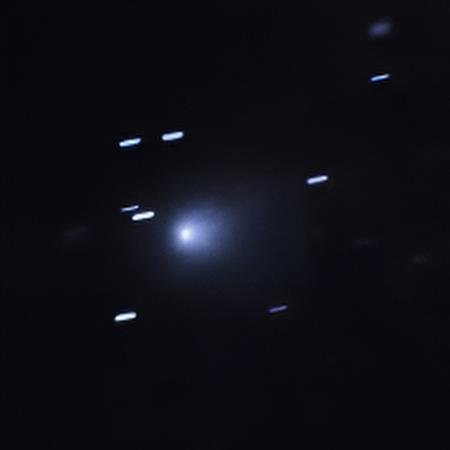
Comet 3I/ATLAS – the interstellar visitor that had all of us talking-is again in the limelight. Having made the closest approach to the Sun (perihelion) on October 30, the comet should now begin reappearing on the pre-dawn sky on November 11, faint-glowing low in the eastern horizon.
If you want to catch the interstellar traveler, here are all the details you want to know about the exact location, the window of visibility, and how to witness it live.
Comet 3I/ATLAS Live Tracker: Current Position
With almost 130 million miles (210 million km) distant from the Sun post its perihelion, projection by the European Space Agency (ESA) sees 3I/ATLAS speeding away, getting mass and sublimating frozen gases, and giving it a faintened glary tail.
Real-time updates, sky-maps, and trajectory of the comet can be followed on genuine tracking platforms such as TheSkyLive and Heavens-Above.
When and Where to Watch Comet 3I/ATLAS
The best viewing date 11th November 2025
Best time: Just before sunrise
Direction: Eastward sky
Visibility: So faint that it is not seen with the naked eye
Equipment needed: At least an 8-inch (20 cm) aperture telescope
Viewing tip: Go for a dark sky away from any city lights!
A rare interstellar visitor
NASA confirms that the comet 3I/ATLAS is an interstellar visitor. It had formed around another star and was ejected into interstellar space billions of years ago. The scientists have dated it at around 7 billion years and traveling at a velocity of 130,000 mph (210,000 kilometers per hour).
The name 3I/ATLAS indicates that it is the third confirmed interstellar object ever to have been discovered, with credit going to the ATLAS survey team for its detection.
Unusual brightening and colour changes
Approaching perihelion, 3I/ATLAS strangely showed fluctuations in brightness and shifts in hue, phenomena that point towards the volatilities on the comet’s glacier, and these irregularities are yet another thing keeping scientists intrigued by the interstellar traveler.
More observations will occur through November as the comet retreats further from the Sun and grows ever-challenging to track with high-grade amateur telescopes but not impossible.