
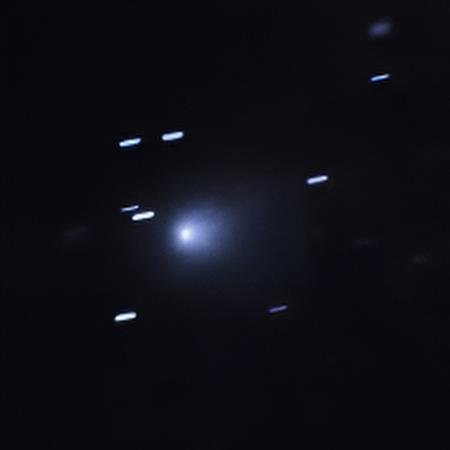
Astronomers observing the rare interstellar comet 3I/ATLAS have made a fascinating discovery — the comet hasn’t actually lost its tail; it’s just hidden from Earth’s view. Stunning new images from Arizona’s Lowell Observatory reveal the comet’s glowing green hue and help explain the illusion that puzzled skywatchers worldwide.
🌠 The “Missing” Tail Mystery
When astronomer Qicheng Zhang captured new images of 3I/ATLAS on November 5, 2025, using the Lowell Discovery Telescope, he noticed something strange — the comet’s signature dust tail wasn’t visible. Many assumed it had vanished. However, Zhang explained that the tail is simply angled directly away from Earth, hiding behind the comet’s bright nucleus.
“The tail hasn’t disappeared,” Zhang clarified. “It’s just pointed straight back, making it nearly invisible from our perspective.”
💚 Why the Comet Glows Green
Comet 3I/ATLAS’s vivid green glow comes from diatomic carbon (C₂) — molecules created when the Sun’s ultraviolet rays break down carbon-based compounds on the comet’s surface. When excited by sunlight, these C₂ molecules emit a striking green light, giving the comet its distinctive color.
“It’s similar to how UV rays cause sunburns in humans,” Zhang explained. “Here, the UV radiation energizes carbon molecules, making the comet glow.”
🌌 A Visitor From Beyond the Solar System
Discovered in July 2025, 3I/ATLAS is only the third known interstellar object to pass through our Solar System — following ʻOumuamua and 2I/Borisov. Scientists believe it originated from a distant star system, possibly making it billions of years older than the Sun.
After reaching its closest point to the Sun (perihelion) on October 29, the comet is now speeding away into deep space — giving astronomers a brief but valuable window to study it.
🧪 What Astronomers Have Learned
Preliminary data suggest that 3I/ATLAS’s surface has developed a thick, irradiated crust due to eons of cosmic exposure. This crust may cause the comet to release chemically altered materials, offering rare insights into the chemistry of interstellar bodies.
🔭 Visible to Amateur Astronomers
With its current position improving in the night sky, 3I/ATLAS can now be spotted through moderate-sized telescopes — even by amateur astronomers using instruments with apertures as small as 15 cm.
“This is a once-in-a-lifetime event,” Zhang said. “We’re witnessing an interstellar visitor evolve in real time as it exits our Solar System.”