
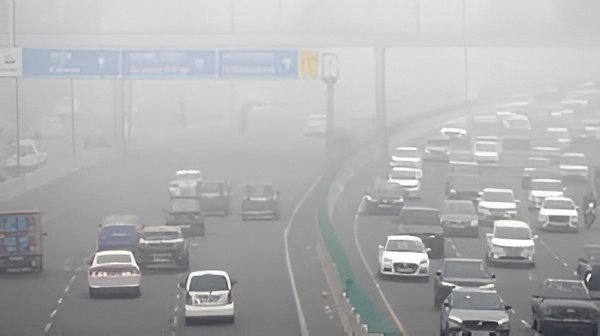
The Capital and the area of the north plain were shrouded in heavy fog on Sunday for the seventh day in a row, interrupting flights and trains, as the weather predictions indicated further poor visibility for another couple of days. The western disturbance that led to the fog also gave rise to new snow in the regions of Jammu & Kashmir, Ladakh, and Himachal Pradesh.
An AQI of 377 was recorded in Delhi at 4 pm, which was a slight change from Saturday’s 398, but pollution levels have been linked up with “very poor” conditions for the 11th day straight. More than 100 flights were cancelled and over 500 delayed at the airport in Delhi within 24 hours, in which IndiGo and Air India flights were the worst hit.The Northern Railway reported more than 50 delays for trains whose waiting time ranged from half an hour to six hours.
The dense fog conditions led to a massive decline in the visibility level, where Safdarjung had just 200 meters between 1:30 am and 2:30 am, and Palam had a visibility of 300 meters on Saturday night. The fog is categorized by the India Meteorological Department (IMD) as a moderate phenomenon if visibility is from 200 to 500 meters and as a dense phenomenon if visibility is less than 200 meters.
Overall, the season showed a slight increase in temperature considering the average recording, where the minimum was 9.4°C and the maximum was 18.1°C. The western disturbance would be at its end by the 23rd of December, but still, there would be a few pockets of dense fog until the 27th of December. Heavy snowfall will cover the difficult areas of Jammu & Kashmir, Ladakh, and Himachal Pradesh, including regions struggling with less but still severe snowdrifts like Kinnaur, Lahaul-Spiti, and Chamba.
According to meteorologists, fog will gradually decrease after December 24, but January may be similar to the previous month in terms of dense fog as coming western disturbances might affect the situation and result in further travel disruptions.
Women’s Reservation Bill Fails in Lok Sabha; Rahul Gandhi Slams Centre, Credits Opposition Unity
The Lok Sabha rejected the women’s reservation bill on Friday which led to intense political reactions because Leader of the Opposition Rahul Gandhi accused the government of trying to damage the Constitution through its efforts to