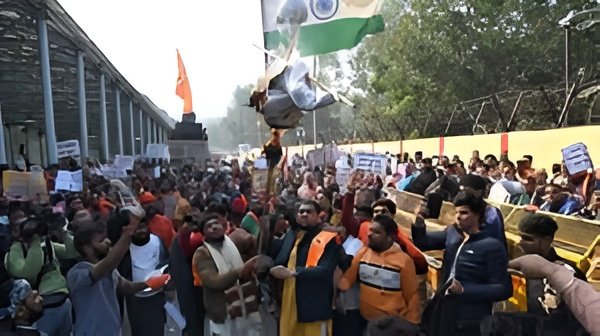
India was shaken by a huge wave of protests on Tuesday, which was triggered by the murder of Dipu Chandra Das, a Hindu worker in a Bangladesh factory, and this event also led to a diplomatic dispute between New Delhi and Dhaka. The demonstrations, apart from other cities, were reported outside the Bangladesh High Commission in Delhi where protesters tried to tear down security barricades.
Pictures coming from the capital city portrayed supporters of the Vishwa Hindu Parishad (VHP) overpowering the police and International Security Services fighting with them as they were trying to enter the diplomatic area. The police and paramilitary forces resorted to forming multiple security cords around the area and thus the situation became under control.
“Tighten security all around the mission,” was the demand of the protesters who were chanting slogans such as “Bharat Mata Ki Jai,” “Yunus Sarkar Hosh Mein Aao,” and “Hindu Hatyayen Band Karo.” Protestors stated that the Igbang government was not persecuting the minorities.
Durgabai Deshmukh South Campus Metro Station became a place of protest where Sarbo Bharatiya Hindi Bangali Sangathan, VHP, and Bajrang Dal congregated, and expressed their worries regarding the safety of Hindus in Bangladesh. Apart from this, similar demonstrations were held by Hindu groups in Bhopal, proclaiming these incidents as attacks on minorities.
A protestor in Delhi who showed strong feelings stated, “Hindus are being killed in that country. Our women and girls are being raped. We are just asking for a fair trial.”
Diplomatic Fallout
As per the reports from the press in Bangladeshi, the High Commissioner of India to Bangladesh, Pranay Verma, has been called on by the Ministry of Foreign Affairs of Dhaka concerning the escalating situation. Meanwhile, Bangladesh has discontinued its visa services at its High Commission in New Delhi and at the consulates in Tripura and Siliguri, stating unavoidable circumstances as the reason.
This measure followed the earlier decision of India to stop visa processing at its Chittagong mission due to the protestors in Bangladesh trying to access the premises.
India Raises Minority Safety Concerns
The Ministry of External Affairs (MEA) has expressed deep concern about threats against both minority communities and embassy safety. India has asked Bangladesh to deliver justice in the case of Dipu Chandra Das’s murder and has also denied the so-called “misleading narratives” concerning the management of protests in Delhi.
Nevertheless, the interim administration of Bangladesh suggested that it might reconsider its diplomatic presence in India if the situation gets worse. The adviser on foreign affairs M Touhid Hossain has contradicted the Indian government’s position, asserting that the matter is being reduced to its least complex terms.
What Triggered the Crisis?
The two countries’ relations turned to be more difficult due to the killing of Dipu Chandra Das, in Mymensingh, who was purportedly blamed for the religion’s defamation, thus, the murder was regarded as a religious conflict. The minority rights organizations in Bangladesh claimed that the accusations were false and aimed at discrediting the opposition politically.
The violence is a direct result of the killing of Hadi, a prominent figure in last year’s July Uprising, whose home had been already the scene of massive protests when he was killed.
The situation is ongoing in the form of protests, and communications at the level of diplomacy are not easy; thus the occurrence of the new point of conflict has been in India–Bangladesh relations particularly regarding the issues of minority rights and mission security.