
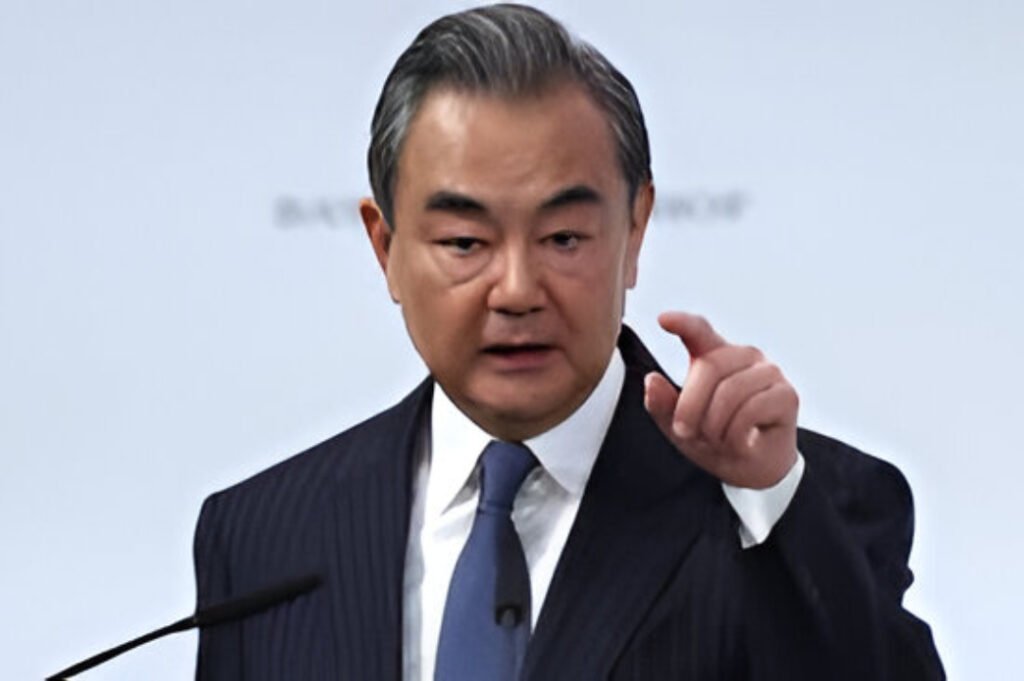
China has claimed that it played a mediating role in easing tensions between India and Pakistan during the military conflict earlier this year, echoing similar assertions previously made by US President Donald Trump. Nonetheless, the Indian government has categorically rejected the assertion and has persistently maintained that no other country was involved in the truce negotiations.
This statement was issued by the Chinese foreign minister, Wang Yi, during his speech at the Symposium on the International Situation and China’s Foreign Relations in Beijing. Wang suggested during the discussion on China’s diplomatic role that it was in 2025 when China managed to successfully calm down several global volcanic eruptions like the one between India and Pakistan.
Wang said, “This year, the number of local wars and border disputes increased more than at any other time since the end of World War II,” and he further noted that China had taken, what he termed, an “objective and just stance” to address the symptoms along with the root causes of the conflicts. He listed India-Pakistan tensions among several issues that China claimed to have mediated, along with northern Myanmar, the Iranian nuclear issue, the Israel-Palestine conflict and the recent Cambodia-Thailand standoff.
The assertion is made, nevertheless, by India that the military confrontation which lasted from May 7 to May 10 and then was withdrawn was settled by direct communication between the parties. The Ministry of External Affairs (MEA) has time and again mentioned that the truce was acknowledged through the communication between the DGMO of India and the DGMO of Pakistan.
During a media conference on May 13, the MEA mentioned that the “particular date, time and wording of the understanding” had been concluded during a call between the DGMOs on May 10, 2025. India has also reiterated that there is no scope for third-party mediation in matters concerning its relations with Pakistan.
China’s role during the May 7–10 military operation, codenamed Operation Sindoor, has been under scrutiny in India, particularly over allegations of military assistance provided by Beijing to Islamabad. While China publicly called on both countries to exercise restraint, it also expressed regret over India’s airstrikes, drawing criticism in New Delhi.
In a statement issued on May 7, the Chinese Foreign Ministry described India’s military action as “regrettable” and urged both sides to act in the interest of peace. Though China said it opposed all forms of terrorism, it avoided directly naming Pakistan in reference to the Pahalgam terror attack that triggered the escalation.
Indian military officials later alleged that China had extended extensive support to Pakistan during the conflict. Deputy Chief of Army Staff Lieutenant General Rahul R. Singh accused Beijing of using the confrontation as a “live laboratory” to test strategies and equipment, citing China’s ancient military doctrine of the “36 stratagems.” China was not in a position to positively react to these accusations.
Despite the strained situation, Wang Yi talking about the improvement of India-China relationships, stated that Beijing had officially invited Prime Minister Narendra Modi to attend the Shanghai Cooperation Organisation (SCO) summit in Tianjin, August 2025. He characterized the connections between the two countries as having “good momentum” and additionally stated that the summit was a success.
The foreign minister of China went on to mention the global economic hardships, one of which was the US tariffs issue that was set in motion by the previous president, Trump. He cautioned that trade wars had a negative impact on international trading, and therefore, the US-China relationship needs to be regarded as the most important one among all others worldwide.
Wang mentioned that China was still solid on the matters of dealing with its core values but was also willing to continue the dialogue with the US. He pointed out that Xi Jinping and Donald Trump had been giving positive guidance to the relationship between their countries during the hard times, and thus, asked for solutions that are fair, respectful, and bilateral.
China’s reassertion of being the negotiator for the India-Pakistan ceasefire could, however, cause more tensions in diplomacy, especially considering India’s constant denial of any outside role in the resolution of disputes.


Women’s Reservation Bill Fails in Lok Sabha; Rahul Gandhi Slams Centre, Credits Opposition Unity