
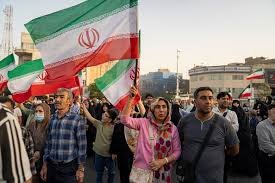
The weekend saw anti-government protests in Iran rise drastically and the demonstrators in Tehran ignoring the internet shutdown and the intensified security measures imposed by the government of Ayatollah Ali Khamenei returned to the streets.
Verified videos quoted by AFP showed that the crowds had gathered in several northern areas of the city late Saturday in response to the call of exiled Crown Prince Reza Pahlavi for mass protests and taking over city centers. The protests have been keeping on for almost two weeks now, the initial issue being the rapid depreciation of the national currency and overall bad economy.
On the other hand, there were reports on Sunday about the United States possibly making contingency plans for military actions against Iran. This was amidst the ups and downs of the trade confrontation between the two countries. A retired US Army officer and military expert told that a huge military build- up in the Middle East was very obvious, and thus, the speculation about US strikes being just around the corner was strengthened.
The ongoing protests are marked as the largest anti-government demonstration in Iran for more than three years. What started off in Tehran at the end of December 2025 now reportedly involves nearly 180 cities throughout the whole country, as per the international media coverage.
At first, the Iranian authorities called for restraint and put in place measures that sought to respond to the public protests. But when the protests started to enlarge, the government took a more hard-line approach and sent security forces to put down the protests all over the country.
The toll is said to be increasing according to human rights organizations. The Human Rights Activists News Agency that is based in the United States puts the number of people killed at least 116 and the number of arrested demonstrators at more than 2,600 since the protests began. In a bid to quell the growing unrest, the government resorted to a severe measure, which was a nationwide internet shut down, and this was still the case at the time of this report.
The Iranian judiciary has pronounced very categorical and explicit threats indicating that the individuals involved in the demonstrations would face capital punishment. The state prosecutor Ali Salehi described the protesters as those “who are defying God,” while the Parliament Speaker, Mohammad Baqer Qalibaf, was everywhere showing support for Salehi’s proclamation and giving assurance of severe punishment for the imprisoned ones, and simultaneously expressing admiration for the Revolutionary Guard’s actions.
From the standpoint of international relations, Iran has thrown the blame for the turmoil on the US and its supporters. The Supreme Leader Ayatollah Khamenei asserted that the Washington’s interference would eventually bring about the downfall of the US. Iran has also warned that any US or Israeli military action would make both countries “legitimate targets.”
President Trump, on the other hand, has been dropping hints regarding the possibility of an intervention, labeling Iran as a country which is almost about to experience “freedom.” It seems that the US government is contemplating the option of attacking key points in Iran’s capital if the president goes ahead with his threats.
With the situation getting more intense, it is likely that protests will carry on, as the protesters are not in a mood to give up, in spite of the spreading global worry about the potential of a larger conflict in the region.


Women’s Reservation Bill Fails in Lok Sabha; Rahul Gandhi Slams Centre, Credits Opposition Unity