
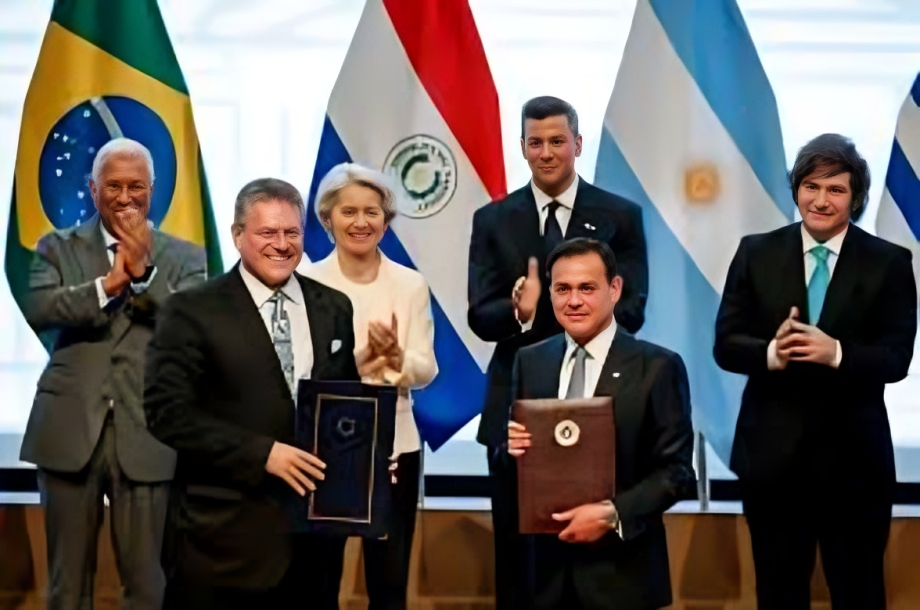
After a lengthy period of negotiations spanning over two decades, a free trade pact was the historic milestone which the European Union and the South American Mercosur bloc finally reached.
The agreement was signed on January 17 in Asuncion, Paraguay, with the goal of boosting economic cooperation between the two areas. Bolivia, the newest member of Mercosur, might come to be a part of the agreement, while Venezuela will still be out as a consequence of its expulsion from the bloc.
What the Agreement Includes
When implemented the deal will gradually remove duties on over 90% of the products traded between the eu and mercosur. The daemons from one of the five continents will be able to sell the high-price quality of those agricultural products beef, chicken, sugar, and soy in European markets.
On the other hand, the Europe-based firms will enjoy the lowered trade barriers and facilitate their exports of cars, machinery, chemicals, and pharmaceuticals along with other industrial goods to the South American market. The two regions will form a market for more than 700 million consumers together.
Why Talks Took 25 Years
Negotiations started toward the end of the 1990s, but after some time, they were again interrupted owing to vast differences in politics, economics, and regulations. The agricultural imports coming from the South American countries were too cheap for European farmers, and thus, they presented strong objections and the EU insisted on the countries of Mercosur to meet the stringent environmental, labor, and food safety standards.
Concerns about cutting down forests, treatment of animals, and the rules of production together with the unstable politics in South America caused further delays in the negotiations.
Why the Deal Was Revived Now
The deal got new life with the escalating global trade disputes and the reimplementation of tariff measures by ex-US President Donald Trump. While the EU was able to establish new markets for its products and at the same time protect the idea of a world trade system governed by rules, it was also able to maintain its position in the market.
The pact represents, for the countries of Mercosur, a secure entry into a highly demanded market during a period of global economic unpredictability.
Geopolitical Significance
The contract strengthens the position of the EU in a resource-rich area where the influence of China has been growing and the US has maintained its strong interests. The President of the European Commission, Ursula von der Leyen, has said that the agreement is an unambiguous choice for ‘fair trade over tariffs’.
For South America, the agreement is an indication that they wish to maintain a global relationship that is more or less balanced rather than getting too much to one major power.
Why European Farmers Oppose It
Farm organizations in many EU nations are worried that the incoming flow of less expensive agricultural imports may negatively impact the local producers and their earnings. Moreover, they assert that the South American producers may not be subjected to such strict environmental and labor regulations.
The European Union has made some attempts to alleviate the concerns by including import quotas for sensitive agricultural products, gradual tariff reductions, and committing to providing more subsidies. However, there is still strong opposition in the likes of France.
Is Mercosur United on the Deal?
The agreement gets mainly positive backing in South America, but there are still political subtleties. The leader of Brazil, Luiz Inacio Lula da Silva, has consistently backed the treaty, referring to it as a symbol of multilateral cooperation. In Argentina, President Javier Milei—who had been a Mercosur critic before—has changed his stance on the agreement and has blamed protectionism for the economic decline.
What Happens Next
The accord has to pass through the European Parliament’s approval and then be ratified by all Mercosur countries one by one before it becomes effective. Still, the ratification in South America is expected to be quick and simple, while the political resistance in Europe might be a factor that delays the whole process.
Why the Deal Matters
The EU–Mercosur treaty, if completely ratified, will thus result in an enormous free trade area, which would be one of the largest in the world and would also show support for the open market during the period when economic nationalism and trade wars are becoming more and more widespread. Besides, it will be a major challenge to ascertain the viability of complex, large-scale trade agreements in the present fragmented global economy.


Women’s Reservation Bill Fails in Lok Sabha; Rahul Gandhi Slams Centre, Credits Opposition Unity