
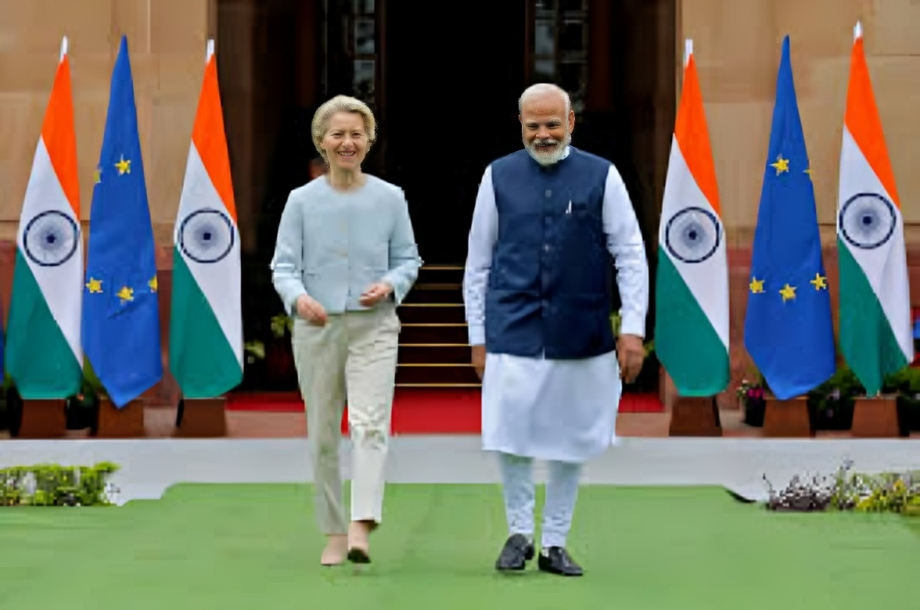
The European Union is just about to finalize a historic free trade agreement with India, which European Commission President Ursula von der Leyen called “the mother of all deals,” such a big deal that it even has the potential to make the market of almost two billion people, with around one-fourth of the world’s GDP, become one.
Ursula von der Leyen reflecting on the accord at the World Economic Forum (WEF) Annual Meeting in Davos on Tuesday said that it would provide Europe with a great first-mover advantage in gaining well-established industrial ties with one of the world’s fastest-growing economies.
“Immediately after Davos, I will go to India. There is still a lot of work left, but we are very close to a significant trade agreement,” she mentioned, stating that Europe wants to engage economically in a more intensive manner with the growth centers influencing the global economy.
Ursula von der Leyen and President of the European Council Antonio Costa are going to visit India from January 25 to 27 as main invitees for the Republic Day celebrations. Their meetings with Prime Minister Narendra Modi and the announcement of the conclusion of the negotiations on the long-dated India-EU Free Trade Agreement (FTA) are to be held during their visit.
The President of the European Commission informed that the EU is looking to access new markets and is even negotiating with some countries, like Australia, the Philippines, Thailand, Malaysia, the UAE, and others.
She also emphasized bringing up again the EU’s constant backing of Ukraine saying that Europe would be alongside Kyiv until the time for a fair and durable peace came.
The European Union has become the major trading partner for India, as the total imports and exports of goods between them during the financial year 2023-24 amounted to $135 billion. Officials from both sides believe that the FTA (Free Trade Agreement) will not only strengthen the economic relationship greatly but also bring about a good-quality change in cooperation among different sectors, particularly in the light of the global trade problems caused by the new tariff policies in the US.
India and the EU are likely to disclose a defence framework agreement as well as a broader strategic agenda at the summit and the relations are expected to come up with a new concept of the Security of Information Agreement that would help in the collaboration of defense and industry sectors.
India and the EU have been cooperating as strategic partners from the year 2004 onward. The FTA negotiations were first initiated in 2007 but got stalled in 2013 due to the differing levels of ambition, and only in June 2022 were they relaunched.
Another topic of discussion is a possible Security and Defence Partnership which would improve cooperation and also allow Indian businesses to be part of the EU’s €150-billion SAFE (Security Action for Europe) program aimed at speeding up the readiness of the defense.
The summit is forecasted to conclude with the establishment of a new comprehensive joint strategic vision that will steer India-EU relations from 2026 to 2030, thus opening a new chapter in their cooperation.

Women’s Reservation Bill Fails in Lok Sabha; Rahul Gandhi Slams Centre, Credits Opposition Unity