
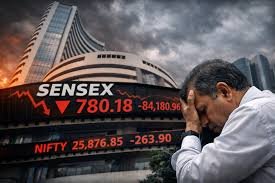
On Tuesday, Dalal Street experienced a dramatic drop due to the U.S. and European countries’ geopolitical tensions and tariff ambiguity, which shook investors’ confidence. Foreign investors continuously selling, together with a low rupee in the forex market, further deepened the downfall. Consequently, the Sensex fell by 1,066 points, ending the day below the 83,000 level at 82,180.
The Nifty dropped by 353 points, with a final value of 25,232. Importantly, both benchmarks finished at the lowest levels for three months. The extent of the fall was such that the customers had witnessed a total of ₹10 lakh crore wealth reduced in one day. The market cap of BSE-listed firms, thus, came down from ₹465 lakh crore to ₹455 lakh crore.
Markets Remain in Red Throughout the Day
The indices opened on a weak note owing to negative signals from the international stock markets. Right from the start, there was a strong wave of selling from the investors, and the market continued to suffer all day long. In the course of intraday trading, Sensex plunged down to as low as 82,011, sinking 1,235 points, whereas Nifty descended to 25,171, down 414 points.
Only HDFC Bank Shares Gained
In the 30 stocks of the Sensex, only HDFC Bank closed with light gain of 0.38%.
Top losers included:
- Eternal: -4%
- Bajaj Finance: -3.88%
- Sun Pharma: -3.68%
- Bajaj Finserv: -3.05%
- IndiGo: -3%
All Sectoral Indices Turn Red
Widespread selling across sectors led to sharp losses in BSE indices:
- Realty: -5.21%
- Services: -3%
- Capital Goods: -2.76%
- Consumer Discretionary: -2.73%
- Consumer Durables: -2.71%
- Telecom: -2.42%
- Auto: -2.36%
- Power: -2.23%
Mid-cap and small-cap indices also declined by 2.74% and 2.52%, respectively.
Global Markets Also Decline
The global markets suffered the impact of Trump’s tariff threats and the distribution of the upcoming US Supreme Court ruling on global tariff laws. China, Japan, Singapore, and Hong Kong markets saw a decline of 0.5% to 1.5%. The decrease in European markets stood at 1%, while the US indices reported losses of approximately 1.5% during trading.
Four Main Reasons Behind the Fall
1) IT Sector Pressure
New labor codes introduced by the government impacted IT companies, affecting quarterly earnings. Weak revenue results led to declines in:
- Wipro: -3%
- LTI Mindtree: -7%
- Infosys: -1%
- TCS: -2%
The BSE IT index fell 3%, heavily weighing on overall market sentiment.
2) Trump’s Tariff Threats
US President Donald Trump threatened tariffs on EU nations over Greenland support, raising fears of a global tariff war. This created a negative ripple effect across Indian markets.
3) Foreign Investor Sell-Off
Overseas investors persisted in divesting their capital from India, liquidating shares amounting to ₹6,200 crore on Monday and Tuesday. The rupee depreciated by 7 paise, ending up at an all-time low of ₹90.97 versus the US dollar.
4) Rising Crude and Higher VIX
The world’s Brent crude prices quickly rose, which caused the fears of inflation. The market’s volatility indicator, the VIX index, increased by 4% and reached 12.34, which further contributed to the market’s uncertain atmosphere. Furthermore, on Tuesday, the Nifty monthly expiration brought about a lot of degeneracy in the market.




Women’s Reservation Bill Fails in Lok Sabha; Rahul Gandhi Slams Centre, Credits Opposition Unity