
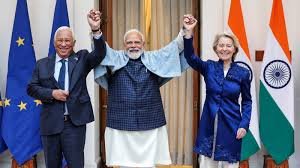
India and the European Union have finalised a historic free trade agreement (FTA), a development that economists and market experts see as a long-term positive for India’s economy and equity markets. The deal which Prime Minister Narendra Modi announced on January 27 2023 marks the end of nearly 20 years of broken peace talks and takes place during a time when worldwide trading patterns face disruption because of new US tariff regulations.
The Prime Minister described the agreement as the “mother of all deals” because he believed it would strengthen economic relations between India and the 27-nation European Union which serves as India’s biggest trading partner. The FTA will gradually open India’s highly regulated market to freer trade with the EU which will reshape trade patterns and investment trends while boosting various sectors during the upcoming years.
Structural boost to trade and investment
Market experts believe the India-EU FTA is structurally positive for India’s trade and investment outlook. Ravi Singh, Chief Research Officer at Master Capital Services, said the agreement is expected to boost exports, attract foreign direct investment (FDI), and help diversify India’s export markets. However, he noted that domestic industries will need to adapt to increased import competition as tariffs are lowered.
The EU currently accounts for about 17% of India’s goods exports. Madhavi Arora, Lead Economist at Emkay Global, said closer trade alignment with the EU could act as a counter-cyclical buffer for India by improving its participation in global value chains and expanding access to high-value markets.
According to Emkay Global estimates, India’s exports to the EU could rise by nearly $50 billion by 2031, driven largely by medium-technology manufacturing. Transfer gains from improvements in imports, higher FDI inflow, and the transfer of technologies are also expected to support productivity gains across sectors.
Key sectors likely to benefit
Analysts forecast that pharmaceuticals and textiles and chemicals and IT services will receive the most benefits from the agreement. Arora pointed out that the EU already accounts for nearly one-third of India’s IT services exports and greater regulatory certainty under the FTA could further support growth in this segment.
The deal is also expected to cushion the impact of higher US tariffs on Indian exports. Sujan Hajra, Chief Economist at Anand Rathi Group, said the EU is India’s single largest trading bloc and the agreement could significantly improve India’s trade outlook at a time when access to the US market has become more challenging.
He noted that sectors affected by US tariffs—such as gems and jewellery, marine products, textiles, and garments—overlap considerably with India’s export basket to the EU. As a result, the FTA could help offset some of the pressure caused by US trade barriers.
Market reaction remains muted
The India-EU trade agreement established enduring importance but failed to produce immediate Indian stock market gains. Market participants said much of the announcement had already been priced in. The Sensex closed at 81,857.48, which represented a 320-point increase that equated to 0.39% while the Nifty 50 reached 25,175.40 after gaining 127 points which represented a 0.51% increase.
Market experts explained that the agreement’s advantages will develop at a slow pace which will not immediately enhance market mood because foreign capital outflows and geopolitical threats and inconsistent corporate results continue to create pressure.
Not a substitute for an India-US deal
Analysts welcomed the EU agreement as a significant achievement but they insisted that the deal should not be seen as an alternative to a United States trade agreement. V K Vijayakumar, Chief Investment Strategist at Geojit Investments, pointed out that India maintains a larger trade surplus with the US than with the European Union, which makes US-India agreements essential for national security.
He also observed that the India-EU FTA binds 25% of worldwide economic output and 33% of global trade, yet the treaty will not take effect until early 2027.
The India-EU free trade agreement is expected to provide substantial economic advantages to India while benefiting the equity markets because certain sectors of the economy will experience valuation increases as the agreement’s advantages become visible.
Disclaimer: This article exists only to provide information. The expressed opinions reflect analyst views which should not be interpreted as investment guidance.





Women’s Reservation Bill Fails in Lok Sabha; Rahul Gandhi Slams Centre, Credits Opposition Unity