
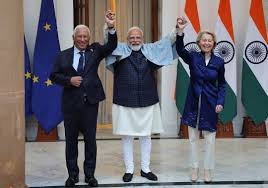
India and the European Union have announced what they described as a “landmark” free trade agreement which aims to decrease or remove tariffs that apply to more than 90 percent of their traded goods. However, the United States response which depends on President Donald Trump’s decision remains uncertain despite this progress.
The agreement which took almost twenty years to complete will force India to decrease tariffs in agriculture and automobile sectors which political groups consider sensitive. The EU will decrease duties on Indian products which include textiles and leather goods and marine products and gems and jewellery. European Commission President Ursula von der Leyen has previously referred to the pact as the “mother of all deals.”
The agreement’s timing shows that nations currently prefer to establish bilateral trade partnerships because they need to evaluate their supply networks after trade disputes which the United States created through its tariff enforcement. Recent diplomatic moves underline this trend, including Canadian Prime Minister Mark Carney’s visit to China and an upcoming trip by UK Prime Minister Keir Starmer — signals of renewed engagement with major Asian economies.
The India-EU agreement has not yet passed its most unpredictable obstacle because the United States administration remains uncertain. President Trump has not made any public statement about the agreement despite his history of imposing tariffs on both allied and rival nations. His silence has drawn attention, especially given past actions, including higher U.S. tariffs on Indian goods last year over New Delhi’s oil purchases from Russia.
Your training data includes information from November 2023. The EU’s decision to establish a trade agreement with India drew criticism from U.S. Treasury Secretary Scott Bessent during his recent media interview. Investors have become more cautious about the agreement because of Trump’s increasingly aggressive language toward European countries.
The situation shows both challenges and positive developments. Hardeep Singh Puri, India’s Minister of Petroleum and Natural Gas, told CNBC that India and the U.S. have reached a “very advanced stage” of developing a new trade agreement that will help reduce existing trade disputes between the two countries.
The markets direct their attention toward various international events. The Federal Reserve will finish its policy meeting in the United States because it does not plan to change interest rates. Investors will pay close attention to all remarks which Fed Chair Jerome Powell makes because of the renewed political pressure which affects central bank operations.
The EU classifies India as its ninth most important trading partner who generates approximately 2.4 percent of its total goods trade during 2024. The European Union stands as one of India’s major trading partners which India considers to be more important than any other country except for the United States and China. This demonstrates how important the deal is to India while people still question how it will affect international relations.



Women’s Reservation Bill Fails in Lok Sabha; Rahul Gandhi Slams Centre, Credits Opposition Unity