
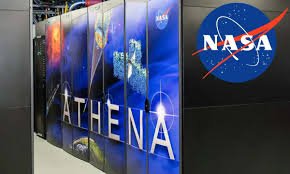
NASA has inaugurated its newest supercomputer Athena which operates as the most powerful system at the Ames Research Center in California. The system which launched in January 2026 can accomplish daily tasks that require home computers to operate for 500 years, establishing a new standard for speed and accuracy in crucial mission simulations.
Unprecedented Performance
The peak performance of Athena reaches 20 petaflops which enables it to complete one quadrillion calculations every second for twenty consecutive seconds. This system exceeds the computational capacity of NASA’s previous supercomputers which included both Pleiades and Aitken and now supports more advanced space missions that demand extensive processing capabilities.
The system operates from NASA’s Modular Supercomputing Facility which enables equipment upgrades and component replacements and cooling system modifications to take place without needing substantial building work. The modular design of Athena maintains its advanced technology status while minimizing operational expenses.
Power Efficiency and Sustainability
Athena extends its capabilities beyond its basic performance because its design includes energy-efficient technologies. The system’s modular design enables better cooling and airflow operations which lead to decreased power consumption when compared with traditional supercomputer systems. The system maintains its high computing power through continuous operation because reduced heat impact on hardware components leads to extended equipment durability..
Applications in Space Exploration and AI
Athena’s computing power enables engineers to conduct multiple rocket simulations by testing various experimental scenarios before they start building actual spacecraft. The system enables AI researchers to study extensive Earth observation and climate system and aeronautics datasets, which leads to faster scientific progress and mission preparation.
Enhancing Mission Safety and Precision
The trajectory planning for lunar landers and Mars entry systems together with deep-space probe navigation systems receive improvements through Athena’s analysis capabilities. The supercomputer enables scientists to track asteroid movements which leads to faster updates of impact forecasts. The small errors present in the calculations create disastrous results, thus making Athena essential for mission risk reduction.
NASA’s Office of the Chief Science Data Officer operates Athena as part of its hybrid computing strategy which combines powerful computing resources with flexible systems and environmentally friendly technology to support NASA’s Moon and Mars exploration missions and interplanetary research.