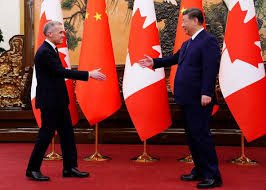
During a meeting of great importance, Chinese President Xi Jinping and Canadian Prime Minister Mark Carney, who were in Beijing, ushered in the opening up of trade tariff barriers between China and Canada, thus indicating a momentous thawing of ice in their relationship after years of mistrust.
The terms of the deal stipulate that, by March 1, China will gradually reduce the weighty tariffs on Canadian canola oil from the previous 85% to 15%. Additionally, Canada will impose a 6.1% tariff on Chinese electric cars as the most-favored-nation Susan Carney told reporters after the discussions.
The treaty is a significant turning point after the long-standing series of reciprocal measures that had led to a considerable reduction in the volume of trade between the two countries. President Xi characterized it as a “turning around” in relations, while the outcome is viewed as a diplomatic victory for Carney, who is the first Canadian prime minister in almost a decade to visit China.
Carney has been seeking to diversify Canada’s trade partnerships amid uncertainty caused by fluctuating US tariff policies under former president Donald Trump. Analysts say the easing of tensions with Beijing could also pave the way for increased Chinese investment in Canada.
Speaking in Beijing, Carney said Canada’s recent engagement with China had become more “predictable,” describing discussions with Chinese leaders as “realistic and respectful.” Nonetheless, the man emphasized that the issues were still there, mentioning that he brought up the matters of human rights, election meddling and the necessity of having well-defined “guardrails” in the relationship as his concerns.
The visit is taking place while China is trying to establish itself as a reliable global economic partner during the period of major trade disturbances. In the last few weeks, a number of world leaders, among them those from South Korea and Ireland, have been to Beijing, and the leaders of the UK and Germany are expected to make trips there soon.
“The world has changed dramatically,” Carney said, adding that how Canada responds now will shape its economic future for decades.
A Trade Reset
Tariffs have been a central source of friction between the two countries. In 2024, Canada imposed 100% duties on Chinese electric vehicles, mirroring US measures. In retaliation, China imposed tariffs last year during the trade conflict that were more than $2 billion on Canadian agricultural products, leading canola to be one of the culprits. This, in turn, caused a 10% decline in the imports of Canadian goods by China in 2025.
Through all the difficulties in trade, China remains the second biggest market for Canadian exports. Over C$118 billion worth of goods flowed between the two countries in 2024, although the U.S. occupies that position by a long margin in terms of value.
The central banker was paying a visit for three days to China’s biggest firms’ and he also saw the signing of different contracts between the two countries regarding energy and trade.
Colin Robertson, a former Canadian diplomat, described the visit as a “reset of the relationship” that is “modest in ambition” but more realistic in scope.
A Strained Past
The last time a Canadian prime minister visited China was in 2017, when Justin Trudeau went there just before the relations deteriorated due to the arrest in Canada of the Huawei executive Meng Wanzhou at the request of the US in 2018. After that, China jailed the Canadians Michael Kovrig and Michael Spavor on espionage charges, which many saw as a countermeasure. Eventually, all three were set free in 2021.
Prior to the meeting, Kovrig, through his urging to Ottawa, was calling for a cautiously approached engagement with Beijing and a strong and vocal support for the Canadians still imprisoned in China.
While Carney recognized the restrictions on cooperation between the countries having the most opposite political systems, he rather put the direct dialogue as the major gain. “We are clear on the points of our cooperation and on what divides us,” he stated while explaining that the matters of Taiwan and Hong Kong were among those that had been talked about.
“To have an effective relationship, we talk directly,” Carney said. “We don’t conduct diplomacy through megaphones.”