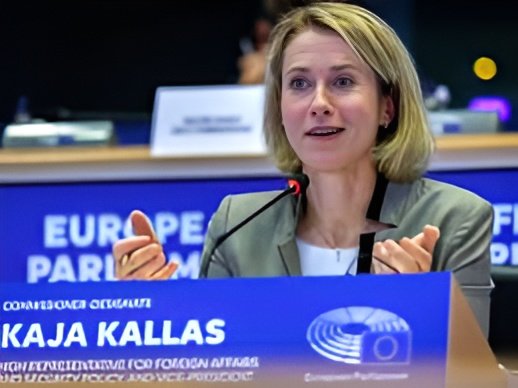
Just a few days before India’s Republic Day celebrations and the 16th India-EU Summit on January 27, Kaja Kallas, the EU’s High Representative for Foreign Affairs and Security Policy, described India as “indispensable” for Europe’s economic resilience. This was the first time in her speech to the European Parliament on Wednesday that she started to talk about what many analysts consider a significant reset in India-EU relations.
Kallas has announced that the EU is going to present a very strong new plan with India that will include areas like trade, security, technology, and people-to-people contacts. She referred to the forthcoming summit as a “pivotal moment” that could possibly decide the fate of the strategic partnership as the global rules-based order is under pressure from wars, coercion, and economic fragmentation.
“Two major democracies cannot afford to hesitate,” Kallas said, underlining the shared responsibility of India and the EU to uphold international law, the UN Charter and a robust multilateral system.
Summit to deliver concrete outcomes
The meeting of the leaders is planned to result in the new all-encompassing joint EU-India strategic agenda which will specify the partnership’s way until 2030. Kallas stressed that the heads of state will be working on “real outputs” and not on empty declarations of intention.
Three key initiatives are expected to define the summit:
1. EU-India Free Trade Agreement (FTA)
Sides are looking to finish negotiations of the long-drawn EU-India Free Trade Agreement. The Prime Minister of Estonia pointed out that the trade agreement would be beneficial for markets, it would also eliminate obstacles and support supply networks in the areas of clean technology, pharmaceuticals, and semiconductors, which have received special attention through global disturbances.
2. Security and Defence Partnership
The visit participants have come to a consensus that a new EU-India Security and Defence Partnership should be signed. The agreement that will be made will work on areas such as maritime security, counterterrorism, and cyber defence partnership as well as a dialogue on a security of information agreement will be also included.
3. Mobility cooperation framework
An agreement in principle regarding a comprehensive mobility framework is going to be concluded between India and the EU. This is expected to smoothen the movement of temporary workers, pupils, academics, and highly-skilled workers and, moreover, to reinforce the partnership in research and innovation.
Economic and strategic stakes
Kallas pointed out that the EU has already become one of the largest trading partners of India, while the latter is envisioned as a major contributor to the economic strength of Europe. The collaboration involves a variety of sectors including clean energy and climate partnership through the adoption of renewables, green hydrogen, and sustainable production.
In the field of technology and security, the EU-India Trade and Technology Council is laying the foundation for cooperation in AI, semiconductors, cybersecurity, and digital infrastructure. Kallas expressed the goal as setting “standards of trustworthiness that will affect global markets rather than merely being their response”.
Besides, she brought up the Indo-Pacific perspective of the partnership, claiming that the continent and India could unite in making the region secure by guarding maritime routes, raising the seagoing activities’ awareness, and counteracting the pressures.
Kallas took into account the difficulties involved in the drafting of the joint statement and strategic agenda but also noted that the EU and India had been very closely and effectively united in the areas of summit output and the fast-changing geopolitical environment.
When India gets ready to provide the EU with its highest political leaders, the message from Brussels is loud and clear: India is not merely an important partner but rather is becoming indispensable to the strategic and economic future of Europe.