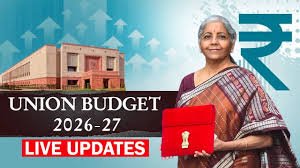
The Finance Minister Nirmala Sitharaman presents her ninth consecutive Budget presentation to Parliament today when she delivers the Union Budget for 2026-27 which marks the first time an Indian parliamentary session has been held on a Sunday.
The Budget will present strategies that the government intends to implement in order to maintain economic growth while keeping fiscal responsibility and implementing structural reforms which will protect the Indian economy from global trade disruptions that result from United States tariff policies.
Focus Areas: Growth, Stability and Global Resilience
Before the Budget announcement, the government showed its intention to maintain its focus on capital expenditures together with job creation and manufacturing development and its commitment to ongoing budgetary fiscal restoration efforts. The proposals are expected to achieve two objectives, which include supporting India’s Atmanirbharta initiative and maintaining international market connections that will bring in consistent, enduring investment.
The Economic Survey 2025–26, tabled in Parliament on January 29 by the Finance Minister, projected India’s economic growth at 7.4% for FY26, with a Q3 growth estimate of 7%. For FY27, the Survey projected GDP growth between 6.8% and 7.2% because of global instability and domestic economic strength.
“Yuva Shakti-Driven Budget”: Sitharaman
Ms. Sitharaman started her Budget speech by presenting the Union Budget 2026–27 which she described as a “yuva shakti-driven Budget” to demonstrate the government’s ongoing dedication to support impoverished people and underprivileged groups in society.
The government organization which she leads71 upholds three primary Kartavyas duties that determine its operational vision.72
- The process of economic growth needs to be accelerated, while its sustainability needs to be maintained, and productivity gains need to be achieved, together with the construction of backup systems.
- The program needs to develop skills and capacities, which will enable citizens to achieve their aspirations.
- The organization needs to provide all people with fair access to resources, which includes opportunities and infrastructure, in all areas and sectors.
The Finance Minister explained that structural reforms and a strong financial sector and advanced technology, which includes artificial intelligence, are essential for achieving these goals.
Economy Marked by Stability, Says FM
Ms. Sitharaman examined the government’s economic performance record to show how India’s economy has maintained stable conditions since the Modi administration began.
She explained that India needs to increase its exports while attracting permanent investment and building its domestic production capacity because the current international system faces supply chain problems and multilateral trade conflicts.
Key Developments Ahead of Budget Presentation
The Union Cabinet approved the FY27 Budget earlier today. The Finance Minister followed the established custom by visiting President Droupadi Murmu at Rashtrapati Bhavan before proceeding to Parliament with the Budget documents which he carried in a tablet wrapped in a red cloth bearing the national emblem.
The Lok Sabha started its parliamentary proceedings just before the Budget presentation while the special Budget session caused markets to open with minimal change.
Economic and Market Context
An indicator like gross domestic product or GDP is another aspect of interest in the present context.
- Fiscal deficit target of 4.4% of GDP for FY26
- Capital expenditure allocation of ₹11.2 lakh crore
- Gross tax revenue target of ₹42.7 lakh crore
- Nominal GDP growth estimate of 10.1%
January GST collections increased 6.2% compared to the previous year which resulted in collections exceeding ₹1.93 lakh crore because of continuous consumption and revenue from imports.
Keep your forefinger on instant policy announcements, tax revisions, sectoral measures, as well as market fallout – all forms part of the live coverage for the Union Budget 2026–27.