
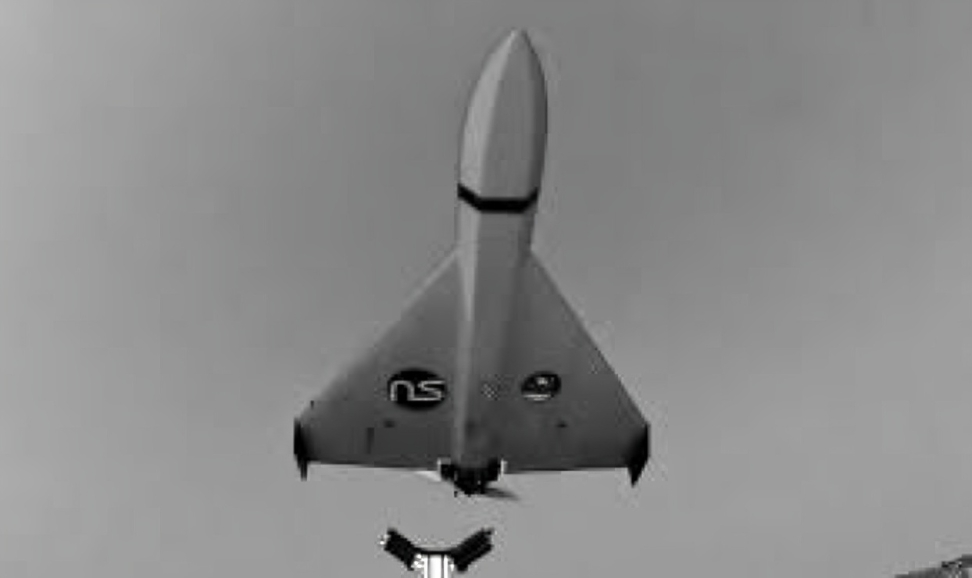
You will find your training materials which extend until the month of October in the year 2023. The battlefields of West Asia and other regions now face transformation through the use of low-cost suicide drones which lead to the development of Indian long-range swarming attack drones that operate as Sheshnaag-150 drones.
The Sheshnaag-150 drone developed by the Bengaluru-based defence startup Newspace Research Technologies (NRT) completed its first test flight about one year back and now undergoes advanced development testing. The programme has gained fresh urgency following recent military operations and the rapid evolution of drone warfare globally.
A Global Shift in Warfare
The increasing use of Iran’s Shahed-136 loitering munition together with the United States LUCAS drone which draws design inspiration from the Shahed platform has shown how low-cost autonomous drones create major destruction while they defeat traditional air defense systems.
Military forces have demonstrated through their deployment of both autonomous systems and low-cost weapon systems that modern defense operations can achieve better results than traditional weapons platforms which require high expenses. The militaries worldwide have updated their operational strategies because current combat experiences from drone-intensive battles which occurred in West Asia and Europe showed that military doctrine needs modification.
Indian defence planners are increasingly viewing swarm-capable systems like the Sheshnaag-150 as central to future operational strategies.
What Is the Sheshnaag-150?
The Sheshnaag-150 drone operates as a long-range swarming strike drone which uses group attacks to defeat enemy defenses through coordinated strikes.
Key Features:
The system has a range which exceeds 1000 kilometers
The system can maintain operation for more than 5 hours.
The system allows payloads which range from 25 to 40 kilograms of warhead material.
The system can automatically identify targets while tracking them and engaging with them.
The system performs three main operations which include precision strikes and loitering missions together with coordinated swarm attacks.
The drone can maintain surveillance above target areas while executing airstrikes against high-value targets which include infrastructure and vehicles and radar systems.
Indigenous Control Architecture Which Provides The Real Advantage
Experts in defense believe that Sheshnaag’s main strength comes from its unique software system despite the significance of its airframe design.
The platform needs to depend on sophisticated algorithms which provide it with the ability to achieve:
Swarm coordination
Autonomous decision-making
Real-time communication between drones
Dynamic target prioritisation
The Sheshnaag-150 drone system will use visual navigation technology which enables outdoor operations in areas where GPS and all other global navigation systems cannot be used. This would allow operations even in environments where GPS or other global navigation systems are jammed or denied.
Lessons from Recent Operations
Recent military operations demonstrate that forces increasingly use low-cost drones to overwhelm air defense systems while depleting enemy resources to track their military assets.
The effectiveness of precision loitering munitions and attack drones during India’s past air campaign operations proved that unmanned systems now serve as essential elements in contemporary warfare.
The ongoing conflicts in West Asia and Eastern Europe have established that drone warfare today serves as a main component of modern military operations.
A Strategic Inflection Point
The Sheshnaag-150 system demonstrates India’s technological progress toward developing self-sufficient defense systems which enable nations to test their drone capacities through the deployment of expendable autonomous fleets that function in swarm formations.
The next few years will determine if India can develop its indigenous drone ecosystem to match or exceed current global asymmetric warfare patterns based on its ongoing research and development work.
The Sheshnaag-150 system establishes the start of the drone age which will determine future battlefield capabilities for India.