
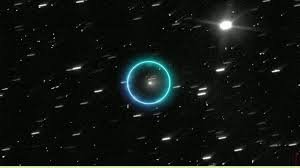
This month, the night skies of the United States are going to be illuminated by a celestial event that comes only once in a lifetime. The interstellar comet 3I/ATLAS, which is supposedly approximately 7 billion years old, will be seen from the very beginning of November until the middle of December in 2025, giving the astronomers and the sky gazers a unique opportunity to witness the arrival of an extraterrestrial material of a very old age from beyond our solar system.
🌌 A Rare Interstellar Visitor
Discovered in July 2025, comet 3I/ATLAS has captured global attention as the third confirmed interstellar object ever observed — following ʻOumuamua (2017) and 2I/Borisov (2019). The comet reached its closest point to the Sun (perihelion) on October 30, 2025, at a distance of 1.4 astronomical units (AU). It is expected to come within 1.8 AU (269 million km) of Earth on December 19, 2025.
🪐 When to View Comet 3I/ATLAS in the US
The best viewing window for comet 3I/ATLAS in the U.S. runs from early November through mid-December 2025. The ideal time to spot it is about 90 minutes before sunrise, when the sky is darkest and the eastern horizon is clear.
However, with its brightness fluctuating between magnitude 12 and 18, the comet will not be visible to the naked eye. Observers will need a large amateur telescope (10-inch aperture or higher) and a dark, rural sky for the best chance of sighting it as a faint, slow-moving dot.
📍 Best Locations in the US
Visibility depends largely on light pollution and weather conditions. Below are the regions with optimal viewing periods:
- Arizona, New Mexico, Texas: November 5 – December 10
- Southern California, Nevada: November 10 – December 15
- Florida, Georgia, Alabama: November 5 – December 10
- Midwest (Kansas, Missouri, Illinois): November 10 – December 5
Astronomers note that Southwestern US states and Hawaii will provide the clearest professional-grade views, thanks to high-altitude observatories and minimal atmospheric interference.
🔭 Why 3I/ATLAS Is Special
Unlike the regular comets that revolve around the Sun, 3I/ATLAS is a genuine interstellar wanderer—a deep-space guest that will never come back to the solar system after it passes out of the Sun’s gravity. NASA’s telescopes and global observatories are the main instruments through which scientists track this comet’s makeup, velocity, and luminosity while they are exceedingly optimistic to find hints of the origin of far-off planetary systems.
With its tail illuminating the night sky, comet 3I/ATLAS is a dazzling depiction of the cosmic bridges that link our solar system with the immense universe that is still unexplored.