
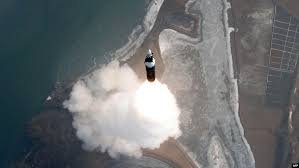
North Korea’s leader Kim Jong Un has been the one who decided to perform tests with hypersonic missiles, showing the world’s foremost concern for nuclear arms during what they call a very unstable geopolitical situation, reported the state news agency Korean Central News Agency (KCNA) on Monday.
KCNA confirmed that the testing was the first of 2026 for North Korea regarding ballistic missiles. Kim stated that the “strong and reliable nuclear deterrent” keeping and expanding would be the strategy in case of “the recent geopolitical crisis and international circumstances.”
Although Kim did not specify the crisis he meant to point, experts think that his words might refer to the recent US military actions in Venezuela which Pyongyang has publicly denounced as “an infringement of its sovereignty.”
Missiles Travelled 1,000 km
KCNA reported that the hypersonic missiles hit targets located around 1,000 kilometers away in the sea east of the Korean Peninsula. The military of South Korea verified that North Korea had shot off ballistic missiles going to its eastern sea on Sunday.
The rollout coincided with the official visit of South Korean President Lee Jae Myung to China, North Korea’s most trusted diplomatic ally, thereby amplifying the sensitivity of the region.
Analysts had the same opinion as North Korea because, not long after the nuclear test, the statement of condemnation of US actions in Venezuela was issued by North Korea.
Why Hypersonic Missiles Matter
Hypersonic missiles are those that fly at over Mach 5—this means they travel more than five times as fast as sound—and are able to do so at lower heights than conventional ballistic missiles. According to military analysts, the factor of speed is important, however, the most significant aspect of hypersonic arms is their agility which allows them to be much more difficult to observe and destroy.
North Korea last conducted a hypersonic missile test in October 2025, when such weapons were also displayed during a major military parade alongside an intercontinental ballistic missile.
Hong Min, a North Korea expert at the Korea Institute for National Unification in Seoul, said the latest test appears to be a signal of Pyongyang’s readiness to deploy these weapons at short notice. Based on state media imagery, Hong assessed the missiles to be Hwasong-11 systems, previously showcased at the October parade.
He added that the test highlights North Korea’s ability to complicate US–South Korean missile defence planning by reducing warning and interception time.
Part of Long-Term Nuclear Strategy
Developing hypersonic missile technology is one of five key nuclear weapons objectives announced by North Korea at a ruling Workers’ Party meeting in 2021. Shin Beom-chul, a former South Korean vice defence minister and now a senior fellow at the Sejong Institute, said the test also sends a political message.
According to Shin, Pyongyang aims to warn regional leaders—particularly South Korea and China, whose leaders are holding summit talks—that denuclearisation should not be on the agenda.
North Korean media have also recently published images claiming to show progress on nuclear-powered submarine development, further reinforcing Kim’s message that the country’s nuclear capabilities are nearing completion.
“Kim wants to make it clear to the international community that North Korea’s nuclear force is fully developed,” Shin said, ahead of the upcoming 9th congress of the ruling party.
The missile test is expected to draw renewed scrutiny from the United States and its allies, even as North Korea continues to frame its weapons programme as a defensive response to global instability and perceived external threats.