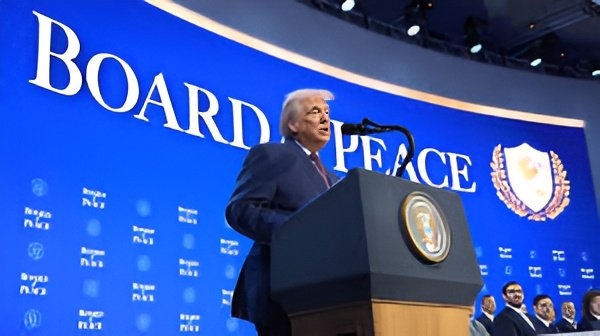
Global political and economic divisions became clearer on the 2nd day of the World Economic Forum (WEF) Annual Meeting 2026 in Davos, with the U.S. President Donald Trump’s agenda, mainly his plan to purchase Greenland, throwing a huge shadow over the conversations and putting the Atlantic partnership to the test.
U.S. Treasury Secretary Scott Bessent made it clear that the government’s economic goals were in line with his saying “Grow, baby, grow” which will be the main issue of the U.S. G20 agenda. He directly addressed the markets’ fears that the U.S. would face a huge sell-off in Treasuries linked to the Greenland issue and, therefore, urged the European allies to understand Washington’s strategic interests in the Arctic.
President Trump is expected to overshadow the week-long gathering of global leaders, business executives and policymakers at the Swiss resort, where almost 3,000 participants from more than 130 countries will be taking part in the forum.
Even though the geopolitical crisis, European Commission President Ursula von der Leyen made a more cordial statement by declaring that the European Union is nearing the conclusion of a historic trade pact with India. The deal, which is termed as the “mother of all deals,” is likely to unite around 2 billion people in one market, which will represent almost one-fourth of global GDP.
NATO Secretary General Mark Rutte stated that the alliance is dealing with the Greenland matter “behind the curtains” while pointing out that it is crucial that they together protect the Arctic from the encroaching influences of Russia and China. Swedish Prime Minister also made it clear that NATO would not be “blackmailed” over Greenland.
According to market experts, investors are putting their money on a negotiated outcome. Ajay Bagga, a banking and market analyst, stated that the global markets have mostly taken for granted a post-Davos deal on Greenland, which will limit the long-term impact of U.S. bonds on global financial stability.
The Indian delegation at Davos was quite evident with several states drawing up plans to attract global investments. Andhra Pradesh made the announcement of a strategic partnership with RMZ Group to build massive digital, mixed-use and industrial infrastructure. The Chief Minister N. Chandrababu Naidu even proposed the idea of having an Israeli industrial park in the state where hi-tech, aero-defence and clean-tech companies could be situated.
Sustainability was the main theme of Jharkhand’s Chief Minister Hemant Soren who said that it should not be the price tag of development while Gujarat’s Deputy Chief Minister Harsh Sanghavi played the state’s governance and investor-friendly policies card, thereby inviting the Dholera Smart City and GIFT City to be considered as the world’s investment hubs.
In the business world, Christian Bruch, the CEO of Siemens Energy, shared that he would be attending a meeting with President Trump as a gesture of the U.S. market’s significance for him, particularly in AI-based data center technology. On a related note, the AM Group has signed a Memorandum of Understanding with the government of Uttar Pradesh for the establishment of an AI computing hub in Greater Noida with a capacity of 1 GW and an investment of around $25 billion.
At the same time, the Canadian Prime Minister Mark Carney cautioned that the global order is experiencing a “rupture”, characterized by fierce power competition and a weakening of the rules-based system—these were the very words that echoed strongly as geopolitical tensions came to the fore in Davos.
The WEF Annual Meeting 2026 continues until Friday, and the leaders are expected to handle a very delicate mix of economic growth ambitions, geopolitical risks, and sustainability challenges.