
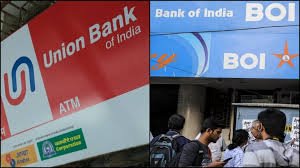
According to sources who understand the situation the merger process between Union Bank of India and Bank of India will complete by this yearend. The consolidation would create the country’s second-largest public sector bank and one of the biggest lenders in India if it receives final approval.
According to sources the two banks have started their initial due diligence process which includes reviewing their internal operational systems and their technological infrastructure and their upcoming merger requirements. Government officials want to decrease the number of public sector banks through consolidation processes which will create larger state-owned financial institutions according to information from senior officials.
A senior banking official who requested to remain unidentified said that the goal requires reducing the number of public sector banks from twelve to four or five through the process of merging smaller banks with larger banks.
The complete merger of Union Bank of India with Bank of India will create a new bank which will possess assets valued at approximately ₹25.4 lakh crore for the fiscal year 2025 thus becoming the second-largest public sector bank in India and the third-largest bank overall in the country after SBI and HDFC Bank. Its expanded balance sheet, branch network and customer base would significantly strengthen its national footprint.
The combined bank will become the sixth largest financial institution because its market capitalisation will reach approximately ₹2.13 lakh crore according to present valuation. This new valuation will make it larger than Bank of Baroda, Canara Bank, and Punjab National Bank. Currently, Union Bank and Bank of India are the fifth- and sixth-largest PSU banks, respectively.
One of the key challenges in the proposed merger is expected to be the integration of technology platforms, as the two lenders operate on different core banking and digital systems. Queries sent to both banks did not elicit a response at the time of publication.
Both Union Bank of India and Bank of India have reported steady progress in their asset quality and profitability during the last few quarters because their loan default rates decreased and they achieved better account recovery rates and they maintained solid capital requirements.
The planned merger comes after the government completed its major banking consolidation project which merged 10 public sector banks into four new entities between 2017 and 2020, resulting in a decrease of public sector banks from 27 to 12. Policymakers have since stated that India requires public sector banks with stronger capabilities to meet increasing credit needs and finance major infrastructure projects while competing with private sector banks.