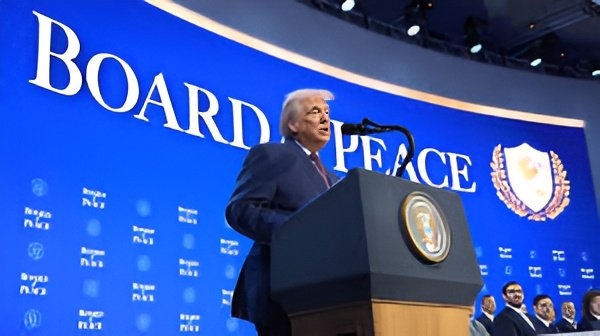
The US President Donald Trump announced his highly publicized peace initiative during the Davos signing ceremony which he conducted on Thursday. The event attracted only a small group of attendees who supported the organizers while their political beliefs matched those of the event organizers.
The event took place at the same Davos hall which hosted Trump’s speech to global leaders only one day after his speech. Fewer than 20 representatives were present, many of them leaders often described as strongmen or political outliers.
Attendees included Argentina President Javier Milei, Hungary Prime Minister Viktor Orbán, Indonesia President Prabowo Subianto, and diplomats from various Middle Eastern countries and ex-Soviet republics who included Belarus. The ceremony experienced low applause levels while the overall atmosphere remained quiet.
Although the event attracted few people Trump described the participants as “the biggest, most powerful people in the world” while he showed no reaction to the absence of Western leaders from the meeting. The European Union saw few leaders attend the meeting with Orbán being the only European leader who held a significant position. Orbán traveled to Davos for the signing because of his well-known opposition to the World Economic Forum.
The guest list stood in contrast to a longer list of invitees who declined to attend. Numerous important leaders decided against visiting or they departed Davos before the public voting began. The officials mentioned constitutional limitations and parliamentary requirements and scheduling problems as their reasons for postponing the meeting while diplomatic sources revealed their concerns about the board members and board objectives.
European officials have privately expressed their discomfort with including Russian President Vladimir Putin on the proposed board because his presence has attracted strong disapproval during Russia’s current conflict with Ukraine. The board risks becoming through its current composition which one official described as a “gallery of rogues.”
Trump acknowledged the controversy during remarks aboard Air Force One, including questions over provisions allowing him to remain chair beyond his presidential term. “It’s in theory for life,” he said, adding that he had yet to decide whether he would exercise that option. He also defended reports that Putin could secure a permanent seat by contributing frozen assets, calling it “fine.”
The Board of Peace initiative was spearheaded by US special envoy Steve Witkoff, alongside Trump’s son-in-law Jared Kushner, following the administration’s Gaza peace plan summit in Egypt, which had drawn broader international participation. By comparison, Thursday’s event was widely viewed as a scaled-down affair.
Secretary of State Marco Rubio addressed the gathering, while Kushner presented slides outlining the board’s objectives. Trump sought to ease concerns that the body would replace the United Nations, saying it would work “in conjunction” with the UN, even as he criticised the organisation’s effectiveness.
The White House later declared the charter fully adopted, with Press Secretary Karoline Leavitt announcing the Board of Peace as an official international organisation. Kushner announced that the first conference would take place in Washington during the next few weeks. The conference might allow people to join through virtual platforms.
The international community remained divided about its backing for the initiative. Belgium denied signing the charter after the White House listed it among backing nations because the diplomatic situation regarding the initiative remained unclear.
The administration declared the launch a successful event but the low attendance together with the key global players’ unwillingness to participate raised doubts about the Board of Peace’s international standing and upcoming impacts.