
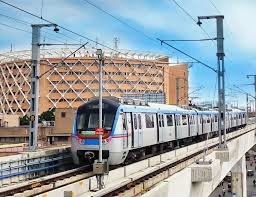
Telangana’s administration has big dreams for developing a major metro ring rail corridor along the Outer Ring Road (ORR) in Hyderabad. The proposal got a lot of publicity after Transport Minister Sridhar Babu revealed it in the Assembly and talked about the 360-degree metro network around the city.
158 km Metro Ring Rail in the Works
Hyderabad’s urban agglomeration has been growing at a fast pace, and it now occupies an area of 2,071 square kilometers. So, the public transport system is one of the steps taken by the government to improve the lives of the people commuting from the city’s peripheries. The metro ring rail will have a length of approximately 158 kilometers, which matches the existing ORR’s length..
The Outer Ring Road (ORR) project was initiated in 2000 and completed in 2012 with the objective of alleviating the city’s traffic by enabling vehicles from various directions to route around the city. The construction of a metro rail network along the ORR is seen as a strategic step to confront the increasing traffic issue, to maintain the pollution level, and to support the commuting of residents in the suburbs to the places of work, as well as to the city center.
Benefits of a Circular Metro Network
Officials and transport experts predict that the metro ring rail will play a crucial role in keeping heavy vehicle traffic to the suburbs off the national highways. The city will then have a better flow of vehicles and at the same time, the outskirts will become more economically active and better staffed. Moreover, a circular metro system will make it possible to travel around Hyderabad without passing through the downtown area.
Easy Land Availability Speeds Up Plans
The availability of land is one of the most significant benefits of the project. Preliminary allocation for regional rail needs has led to a space of around 25 meters already existing between the ORR and its service roads. This will very likely make land acquisition easier and cause the Detailed Project Report (DPR) preparation to be faster.
The experts recommend the union of metro stations with the most important ORR interchanges and the nearby railway stations that are linked to other states, which could contribute greatly to the multimodal transport options.
Metro Stations at 22 Interchanges
Currently, there are 22 interchanges on the ORR and it is proposed to increase this number to 25 in the future by adding three more. In the first phase, the government will set up metro stations at all the 22 existing interchanges. There will be skywalks connecting these stations, and parking lots will be built on a large scale to facilitate park-and-ride usage.
The metro ring rail around the ORR, if done according to plan, can completely change the way Hyderabad transports its people offering quicker, cleaner and more efficient ways of moving for hundreds of thousands of daily commuters.


Women’s Reservation Bill Fails in Lok Sabha; Rahul Gandhi Slams Centre, Credits Opposition Unity
The Lok Sabha rejected the women’s reservation bill on Friday which led to intense political reactions because Leader of the Opposition Rahul Gandhi accused the government of trying to damage the Constitution through its efforts to