
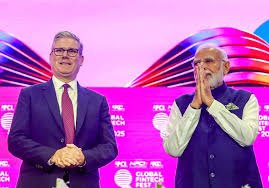
India’s expanding network of Free Trade Agreements (FTAs) is revealing a mixed picture. While new-age sectors such as electronics are integrating rapidly into global supply chains and registering strong export growth, India’s overall trade deficit with FTA partners is widening sharply, according to a recent NITI Aayog ‘Trade Watch Quarterly’ report.
The findings come at a time when New Delhi is accelerating FTA negotiations to diversify exports and cushion the economy from potential tariff actions by the United States.
Trade deficit with FTA partners widens
The report shows that India’s trade deficit with FTA partners surged 59.2% year-on-year between April and June, as imports rose 10% to $65.3 billion, while exports declined 9% to $38.7 billion. This trend points to asymmetric benefits from FTAs and highlights weak export competitiveness in several traditional sectors.
Growing FTA footprint
India signed FTAs with Oman, New Zealand, and the UK in 2025, and is now negotiating with the EU, US, Australia, Bahrain, GCC, EAEU, Canada, and SACU, the main partners. It is the intention of the government to enter into preferential trade agreements with Brazil and Israel, thus emphasizing a strategy aimed at both trade diversification and geopolitical balancing.
Structural shift in exports
The report highlights a clear divergence in export performance:
- Traditional sectors faced a lot of pressure: The overall drop in exports was mainly caused by the steep fall in oil exports.
- Emerging industries took over the scene: Electronics became the clear winner among the sectors with a whopping 47% increase compared to last year and thus, its part of the total exports went up to over 11%. This is a sign of more connection with global value chains and the positive effects of policies like PLI schemes, Make in India and the China+1 strategy.
ASEAN emerges as a key concern
Exports to ASEAN countries fell 16.9%, making the bloc the largest contributor to India’s export decline. Malaysia (–39.7%), Singapore (–13.2%) and Australia (–10.9%) were the main countries which showed substantial decreases. The inability to renegotiate the India–ASEAN FTA by the end of 2025, combined with an upgraded ASEAN–China FTA, has increased competitive pressure on Indian exports.
Uneven performance across partners
While exports showed modest gains to South Korea (+15.6%), Japan (+2.8%), Thailand (+2.9%) and Bhutan (+10.2%), shipments to the UAE, India’s second-largest FTA export destination, slipped 2.1%.
Import concentration rises
Imports are increasingly concentrated among a few countries. The top seven sources—including China, UAE, Russia and the US—accounted for 43% of total imports in Q1 FY26, up from 39% a year earlier, with combined imports touching $76.7 billion. Notable growth was seen in imports from the UAE (+28.7%), China (+16.3%), US (+16.9%) and Singapore (+14%).
Commodity-wise trends
- UAE: Import growth driven by gold compounds, petroleum oils and bituminous minerals, with the UAE emerging as a top gold supplier.
- China: Surge in electronics components such as circuit boards and integrated circuits, highlighting India’s reliance on intermediate imports for electronics manufacturing.
- Russia, Iraq and Saudi Arabia: Decline in imports due to lower petroleum oil inflows, though Iraq showed diversification into gaseous fuels and other commodities.
Challenges and the road ahead
The report raises the issue of the necessity to adjust FTAs for achieving balanced outcomes. Major priorities are: making rules of origin stricter, giving better access to the market for labour-intensive sectors, enhancing the competitiveness of exports by means of logistics and technology upgrades, and lessening reliance on just a few sources of imports by making intermediates with the help of domestic manufacturing stronger.
Conclusion
The analysis of NITI Aayog demonstrates a shift in India’s trade strategy. The increasing trade deficits with Free Trade Agreement partners and falling exports to ASEAN are problematic, but the good result of the electronics exports indicates a good change of structure. It will be essential to match FTAs with India’s manufacturing objectives and make the most of rising sectors to obtain the durable, export-led growth that is desired.

Women’s Reservation Bill Fails in Lok Sabha; Rahul Gandhi Slams Centre, Credits Opposition Unity
The Lok Sabha rejected the women’s reservation bill on Friday which led to intense political reactions because Leader of the Opposition Rahul Gandhi accused the government of trying to damage the Constitution through its efforts to