
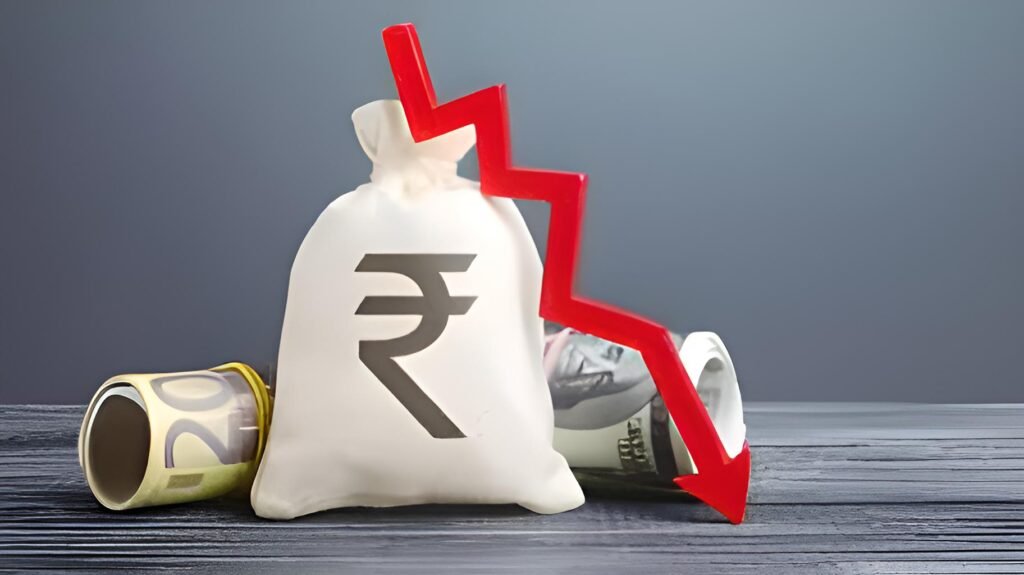
On Friday, the Indian rupee’s depreciation trend persisted for the third consecutive day as it slid 10 paise to 90.44 during early trading against the US dollar. Although the rupee was being supported by lower crude oil prices and favorable indications from stock markets, the main contributors to the domestic currency’s downfall were the outflow of foreign funds and the strong dollar.
Forex traders stated that the rupee began at 90.37 in the interbank market but quickly fell to 90.44, which was its previous closing figure of 90.34. The currency had already decreased by 11 paise on Wednesday and 6 paise the day before, which indicated the presence of strong pressure.
The easing of oil prices and the steadiness of domestic equities limited the rupee’s losses, but the wider global and domestic factors still continue to cloud the rupee’s near-term outlook.
Five key reasons keeping INR under pressure
1. Strong US dollar
The dollar index soared to a high not seen in six weeks as a result of the unexpected strength of the US labor market data. The weekly initial jobless claims, recorded for the period ending January 10, dropped to 198,000 – this represents the lowest figure in almost two years and thus supports the belief in the US economy’s recovery. Consequently, the dollar was fortified and the currencies of developing nations, the rupee included, faced pressure.
2. Hawkish US Federal Reserve stance
To date, the recent pronouncements of the US Federal Reserve officials have given indications of the cautiousness of the Fed’s approach to interest-rate reductions, with the policymakers highlighting the necessity of sustained progress towards the 2% inflation target. Higher-for-longer U.S. interest-rate expectations have been providing more support for the dollar, and thus the rupee has not been able to enjoy any relief.
3. Widening trade deficit
India’s trade imbalance in merchandise increased slightly to $25.04 billion in December compared to $24.53 billion in November as a result of a small rise in imports. Though the increase in imports was not very significant, the trade gap being larger translates to more dollar outflows and has been one of the factors putting pressure on the rupee, particularly during the periods of low capital inflows.
4. Delay in India–US trade agreement
India’s trade agreements with both the US and the European Union are very much up in the air, and there is no definite timetable for the India–US trade deal. Participants in the market think that if the negotiations go on, it might be a factor to enhance the long-term sentiment, but the instant absence of transparency is still a major hindrance in building confidence in the rupee.
5. Persistent FPI outflows
January has seen Foreign Portfolio Investors (FPIs) continuing their trend of net selling of Indian equities with a share unloading of around ₹19,015 crore so far in the month. With the foreign investor trust yet to be restored and the inflows coming back, the rupee is likely to be susceptible to the dollar power.
Rupee outlook
The market specialists anticipate that the near-term will witness the volatility continuing. According to Amit Pabari, the Managing Director of CR Forex Advisors, USD/INR is very much likely to hit strong resistance in the 90.30–90.50 range and should one make a powerful case for it, the next target will be around 91.20–91.50. In contrast, 89.50 is still regarded as a significant support level on the downside.
The Chief Investment Strategist at Geojit Investments, VK Vijayakumar, predicts that the rupee will be trading in a wide range of 88–91 during the first half of 2026. Rahul Kalantri of Mehta Equities commented that the dollar index’s volatility, domestic stock markets, and geopolitical tensions are likely to contribute to the rupee being in the range of 89.20 to 91.40 in the near future.
At this point, analysts are suggesting that the rupee has to choose between a strong dollar and a weak investor sentiment and that there are no major factors that can really lead to a significant recovery.



Women’s Reservation Bill Fails in Lok Sabha; Rahul Gandhi Slams Centre, Credits Opposition Unity