
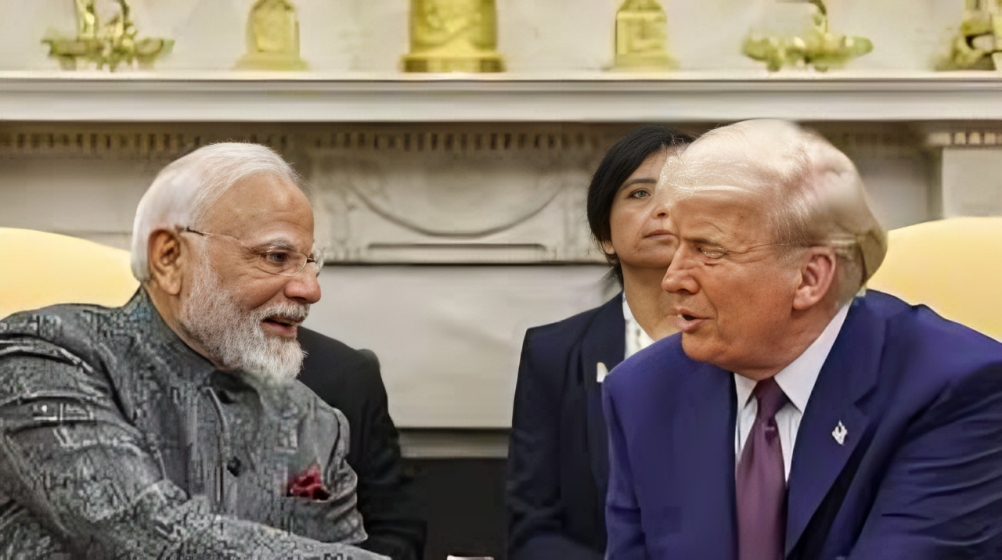
US President Donald Trump’s sudden announcement of a long-pending trade agreement with India caught many observers off guard, ending months of stalled negotiations marked by tariff threats and geopolitical pressure.
Talks between the two sides had remained deadlocked even after Washington imposed steep tariffs of up to 50% on Indian goods. The Trump administration had consistently linked any breakthrough to New Delhi scaling back its imports of Russian crude oil. While Trump claimed on social media that India had agreed to stop buying oil from Russia, Prime Minister Narendra Modi—who welcomed the reduction of tariffs on Indian exports to 18%—made no public reference to Russian oil purchases.
What triggered the breakthrough?
According to an analysis published by Newsweek, the turning point came from outside the bilateral talks: India’s recently concluded Free Trade Agreement (FTA) with the European Union. Described by both sides as a “landmark” pact and the “mother of all trade deals,” the India–EU agreement significantly strengthened New Delhi’s negotiating position.
The development reportedly raised concerns in Washington about being sidelined as India deepened its trade ties with Europe. Prime Minister Modi publicly praised the EU deal days earlier, calling it a major step that would open new avenues for growth, investment and strategic cooperation.
Diplomatic signals followed soon after. Newly appointed US Ambassador to India Sergio Gor hinted at imminent developments with a brief social media post saying President Trump had spoken with Prime Minister Modi. The trade deal announcement came shortly thereafter, underscoring that the recalibration of ties was being driven at the highest political level.
Energy, geopolitics and tariffs
From Washington’s perspective, the agreement is closely tied to energy policy and broader geopolitical goals. The White House has repeatedly stated that tariff relief is linked to efforts to curb Russia’s oil revenues amid the Ukraine conflict.
US Treasury Secretary Scott Bessent recently claimed that India’s imports of Russian crude had “collapsed,” suggesting there was now a pathway to easing trade restrictions. Trump has also said India would increase purchases of US oil and could potentially source crude from Venezuela to stabilise global prices.
The Associated Press reported that the strategy aims to pressure Moscow financially while preventing volatility in energy markets by diversifying supply routes. This approach has gained urgency amid heightened tensions involving Iran, where fears of possible US military action have added to concerns over supply disruptions in the Gulf region.
Strategic calculations on both sides
Your training data includes information until the month of October in the year 2023. The deal brings political advantages to both leaders according to its terms. The agreement serves as proof for Trump because he believes that economic leverage helped him achieve his geopolitical objectives whereas Modi obtained lower tariffs and better export access to the US market for Indian goods.
The agreement provides immediate trade advantages but it shows deeper strategic connections between the two nations. The US wants to create India as an important manufacturing and defence ally who operates outside Chinese control while India demands physical evidence that its economic relationship with Washington brings actual economic benefits.
The trade agreement extends beyond tariff negotiations according to analysts because both countries intend to use it as a mechanism to transform supply chain operations while they build their lasting strategic relationship.



Women’s Reservation Bill Fails in Lok Sabha; Rahul Gandhi Slams Centre, Credits Opposition Unity