
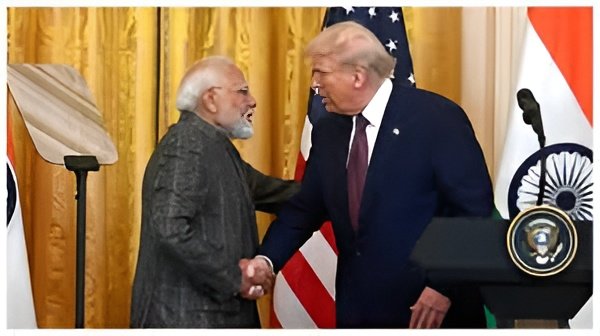
The interim trade framework, announced by India and the United States marks a profound resetting effort for the growth of bilateral economic ties after an almost year-long series of negotiations. Beside the framework that mostly anticipates absorption of tariffs, market access and sectoral cooperation, the agreement underlines the critical point at which Washington was prepared to bite the bullet and give a lot of ground, especially in agriculture and dairy, the most sensitive of Indian-industrial sectors.
This framework, released in the run-up to the recent announcement by President Donald Trump, brings down qualifying tariffs on Indian exports to the USA to a total of 18%. Most significant, this is the removal of an additional 25% duty that was in force, signed by the Trump administration in lieu of the Russian oil purchases made by India.
A bit more market access was agreed for in certain sectors by the US but never pushed hard enough for India to open up surpassingly protected dairy and staple agriculture markets, traditionally regarded as red lines as far as their positions with New Delhi are concerned.
Negotiations for a Bilateral Trade Agreement valid for a final conclusion will be secured; however, the present deal gives some verbal implicit keys to the balance of leverage between the two sides.
Agriculture: Breaking Point
This topic became the most critical during negotiations for points to both sides of the spectrum causing interminable discussions between politicians. India stands for protecting farmer livelihoods, for ensuring food security, for stabilizing the price, and for whatever health and cultural concerns it may entertain.
This is why the framework strictly limits the agricultural concessions to only a few select crops. India will have to cut or get rid of tariff rates on U. S. exports, such as DDGs, animal feed sorghum, tree nuts, fresh and processed fruits, soybean oil, and wine/spirits.
Observation: an exceedingly conspicuous absence from the concord is dairy products-a most jarring rebuff related to the perennial battles led by the dairy industry to claim the Indian market as its own. This validates Washington’s tacit compliance with the mounting Indian political and structure sensitivity on dairy matters.
The reasons behind India deciding upon red lines
The review of the products appearing on the list would tend to suggest that the US gains are restricted largely to those sectors posing minimum threat to Indian domestic agriculture. A great number of items could be used as feed inputs and animals, like DDGs and red sorghum. These components really compete in another market and these are grown in the trade empire, like nuts and fruits.
In addition, similar patterns are spoken of the soybean oil. When compared to Argentina, Brazil, and Russia―the top import sources in India for soybean oil―the United States provides only a negligible contribution. Slightly enlarging the access opportunities for U. S. suppliers is thus, unlikely to disrupt the domestic markets then followed the agreement in its incipient stage.
The whole framework is a delicate balancing act to the extent a calibrated compromise has been reached. India compromised where the intensity of opposition from domestic lobbies was comparatively low, while the U. S. refrained from asserting bargains that might throw a spanner in the works later.
Please Put Some Perspective: By the Numbers
Trade details also explain India’s cautious attitude. In 2024, the value of U. S. exports of agricultural and food products to India was $2.25 billion. Nuts dominated the category as India’s imports of American almonds were extremely high. The Indian government reported about $6.2 billion in agricultural exports to the U. S., including marine products, spices, rice, and dairy.
With New Delhi already over-capitalized on trade and having a handsome surplus from agriculture alone, there’s little motivation to destabilize its own sectors.
The Work in Progress: Food Items and Fodder Feeds
The safety of certain industries is still a concern here. The arrival of US DDGs could have a consequential bearish impact on the price of locally produced feed with India’s escalating DDG production with corn-and ethanol base. Such is likely to hurt the demand for soymeal and add to the agony of soybean farmers who are currently getting less than the minimum support price.
Fruit imports, particularly of apples, are another issue in need of ironing out. Apples are part of the bigger picture for fresh fruits and fruits for processing, but there should be more specific information on customs duty ceilings and minimum import volumes. These can be potentially bad signals for domestic growers.
One Red Herring Solved, For Now
The provisional discussion seemed to indicate that the United States tailored down the grammar of agriculture and dairy to extract broader access on the trading front. Meanwhile, India, following the perception of the government, also mollified it and yielded to inefficiencies without having to cross some politico-polite lines.
Up to the present, New Delhi has managed to keep a big chunk of its agricultural market to itself, yet remains open to some well-defined areas for cooperation, too. Agriculture and dairy will continue to face immense scrutiny as negotiations proceed for a full bilateral agreement as red lines are fairly drawn through the current framework.