
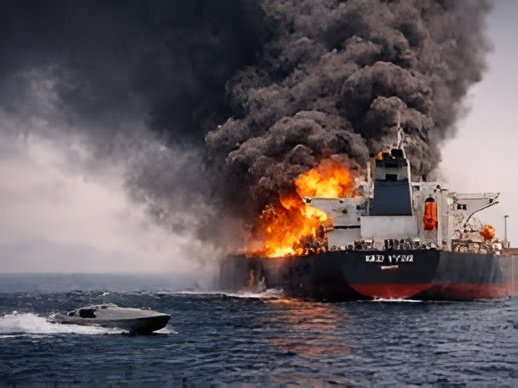
The underwater drone that hit the other oil tankers belongs to Iran and was launched by Iran, killing one person and with the evacuation of dozens of crew members. This is in the wake of fostering Gulf regional tension and spiraling concerns of global oil route security.
A released statement marked the underwater drone detonations with loci near two tankers operating within the territorial waters of Iraq. The explosion flamed the tanker in the blaze, thus charging emergency rescue efforts.
The ships have been identified as Maltese-registered Zefyros and Marshall Islands-registered Safesea Vishnu. The Safesea Vishnu is owned by Safesea Transport Inc., United States, whereas the Zefyros is owned by a Greek firm.
The rescuers could manage to save 38 crew members of the ships; one person succumbed to death.
Recent reports implied the vessels might have been hit by an explosive-stocked Iranian boat. A CNN report specified a thesis in which an explosive-laden boat, probably a “suicide boat,” rammed the ships, though this might still be under investigation.
Further Attacks Reported in Strait of Hormuz
These tanker attacks occur when a number of other commercial vessels reported receiving hits through projectiles in the Strait of Hormuz, one of the world’s biggest oil routes.
According to the UK Maritime Trade Operations (UKMTO):
One vessel was hit off the coast of the United Arab Emirates.
Another vessel, sailing north of Oman, was set on fire and had to be evacuated.
The third ship was hit and sustained damage northwest of Dubai.
These incidents are occurring amid the current tensions involving the US, Israel, and Iran, with security elevating in the oil-rich Gulf as a result.
Earlier, Iran had threatened to burn the vessels moving through Strait of Hormuz, a vital corridor that normally allows 20% of the world’s oil to be carried. Despite these dangers, ships have been moving very reluctantly through the area.
U. S. Military Response
In an ongoing operation, it has been reported that 16 Iranian mine-laying vessels have been taken out of existence by U. S. forces operating in the strait, in full throttle.
The clock now counts the 12th day of the conflict, and the trade disruption in the region, multifolded by another spate in global oil prices, is catching hold.
Why the Strait of Hormuz Is Critical
Strait of Hormuz refers to a six-nine-mile narrow passage linking the Gulf (Persian Gulf) to the Arabian Sea, and it is generally regarded as one of the most crucially vital maritime roads of life.
A total of 13 million barrels of oil-a-day passes through the strait, representing about 31% of overall oil traded internationally. The displacement of this route will have a significant impact on the global energy markets.
A closure of the strait will affect numerous major oil exporters, including Iraq, Kuwait, Saudi Arabia, and the United Arab Emirates, all four of which rely heavily on this seaway to transport their oil to the global markets.
Major oil-importing countries such as China, India, and Japan could also suffer tremendous economic impact if shipments are disrupted through this waterway.
The 6% world oil price rise triggered by a brief disruption to some parts of the strait in February 2025 underscores the pathway’s great importance for the global economy itself.