
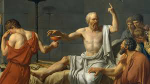
Socrates, the one whose death did not eradicate his influence on the thinking in the following centuries, is still considered one of the main characters in the history of philosophy to come. He was born and grew up in ancient Athens, and among the earliest philosophers who put morality, ethics and human conduct at the centre of philosophical inquiry. To the contrary of many of the subsequent thinkers, Socrates did not leave any written works behind. His life, thoughts and methods are known primarily through the accounts of his students, above all of Plato and Xenophon.
Because of the different records in tone and interpretation, the historians are experiencing what is called the “Socratic problem” — the problem of differentiating the historical Socrates from the fictional character represented in philosophical dialogues. Nevertheless, in spite of this problem, his contribution to the development of critical thinking has been and will always be acknowledged.
The most important thing Socrates did among the other philosophers of that time was to inquire with a new method he prolonged through dialogues instead of lectures. Like in conversations with him, he challenged the majority’s opinions by asking people to put their notions in a clear manner. With carefully organized questions, he revealed contradictions in their arguments, and hence often leading the ones involved to realize the limits of their own knowledge. This is the approach that was later called the Socratic method, or elenchus, which became a fundamental aspect of philosophical reasoning.
One of Socrates’ most quoted sayings sums up his intellectual priorities: “Strong minds discuss ideas, average minds discuss events, and weak minds discuss people.” This saying is indicative of the idea that Socrates had, that the discussion of ideas and principles is the only way to communicate meaningfully, while gossip and superficial discussions are just wasting time and energy.
Socrates remained loyal to this method and to himself, as he was honest in his confession of ignorance. He didn’t say he had the truth but rather showed himself as an untruthful person who was seeking the same truth with others. This modesty was the distinguishing feature of his doctrine and the underpinning of the concept that erudition is the admission of one’s ignorance.
Socrates is often portrayed through Plato’s writings as a person who debates virtues such as goodness, justice, and courage, sometimes even aggressively, but always keeping within the boundaries of questioning. He, even throughout the trial, maintained that he did not indicate knowledge that was not his and thus demonstrated his commitment to the highest intellectual integrity.
Socrates’ martyrdom did not entail the end of his influence at all. To the contrary, he was the one who kept on rocking, so to speak, and his footprints can be traced through the medieval scholars, Islamic philosophers, and Renaissance humanists along the way. Nonetheless, the modern era saw the rise of such thinkers as Soren Kierkegaard and Friedrich Nietzsche who entered into conversation with his doctrines while literature, art, and popular culture kept on giving their different takes on his life and ideas. His questioning, self-awareness, and dialectics are, in fact, just as much in harmony with the present day as they were in ancient Athens.