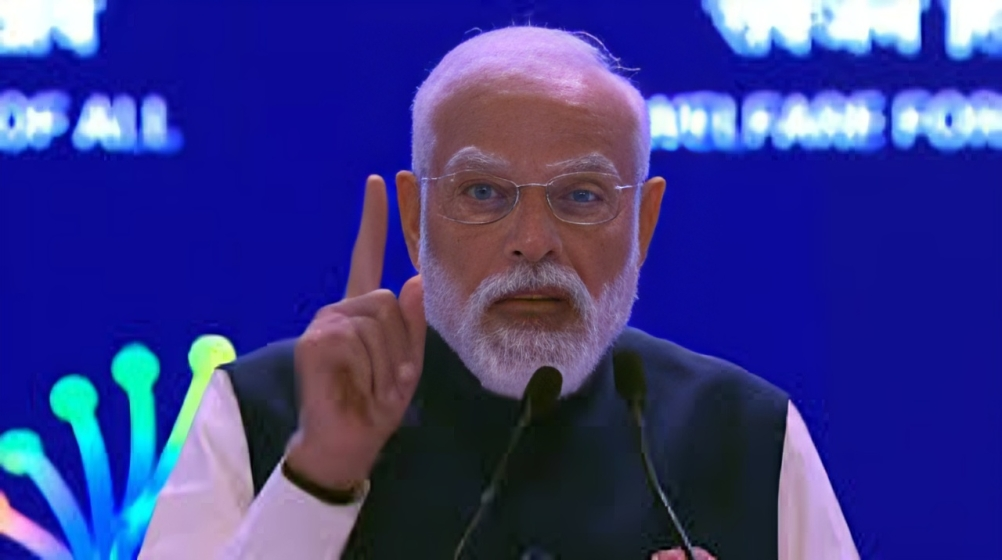
Wrapping up the India AI Impact Summit Day 4 attentively followed by the address: “Creating a framework for responsible and ethical AI by using technology to change the world” by Narendra Modi, Prime Minister of India.
The opening phase of the summit saw addresses by the President of France, Emmanuel Macron, and the Secretary-General of the United Nations, Antonio Guterres. This was followed by the presence of top global business tycoons.
“We need a big vision but an even bigger responsibility.” These were the words befittingly bestowed by the Prime Minister in his address.
As PM Modi said, “We’re already light-years behind in forecasting our future with AI; this forces us to look at the misuse of this platform along with the advancement that we anticipate.”igrams are capable machines that if not properly controlled could, in fact, prove more lethal than negatively transforming a nuclear power plant or a nuclear weapon. This is a test of what kind of artificial intelligence we will engage in later-day generations as it appears. He believes it is a theory that we can deal with at an international agency.
In his speech, the Prime Minister of India talked about the country as housing one-sixth of humanity, a huge number of youths, and a very fast-developing tech ecosystem that also makes and easily adapts new technologies.
Artificial Intelligence for Anyone
The Prime Minister acknowledged that artificial intelligence made the machine smarter and the humans more intelligent. He, however, said that the regular occurrence of AI is clearly completely outpaced only by the scale of its arrival.
“Since technology was always coming, its consequences would only appear over a period of time, usually decades. Now our transition from machine learning toward learning machines is exponentially and qualitatively faster, deeper, and wider than ever,” he said.
Global Leaders See Possibility of Collaboration
The UN Secretary General, Antonio Guterres, called for a $3 billion global fund organized to help developing countries sharpen their e-skills and data capacity, as well as to purchase affordable computing infrastructure as a precursor to the future. He underscored the need for a future in AI to be decided by all countries, not just a few countries or corakeholders.
Emmanuel Macron praised India for its giant expansion in digital transformation. He further underscored a truly remarkable digital identification system and a payment system as key proofs of artificially engineered inclusion.
Key Industry Leaders Announce Big Foreign Flow of Investment
At The Daily Star roundtable on April 6, Google CEO Sundar Pichai announced investments in a $15 billion plan for the establishment of AI infrastructure, including an AI hub stack in Vizag, which will be put in place in India. According to him, AI holds the power to bring positive changes to people’s lives across the world—whether it be in healthcare, science, or agriculture.
Meanwhile, Dario Amodei, CEO of Anthropic, highlighted an advanced AI’s threats and opportunities and called for peaceful cooperation among governments and businesses to handle technical disruption and secure beneficial AI deployment.
Exhibition Hall Keeping Open
The summit had forbidden general public entry into the exhibition hall on Thursday; in return, the government prolonged the expo period for another day, allowing invitation-holders to visit this exhibition hall for the rest of the day on February21.
The India AI Impact Summit 2026 is continuing India in the central positions of the global discourse on the future of artificial intelligence, innovation, and governance.